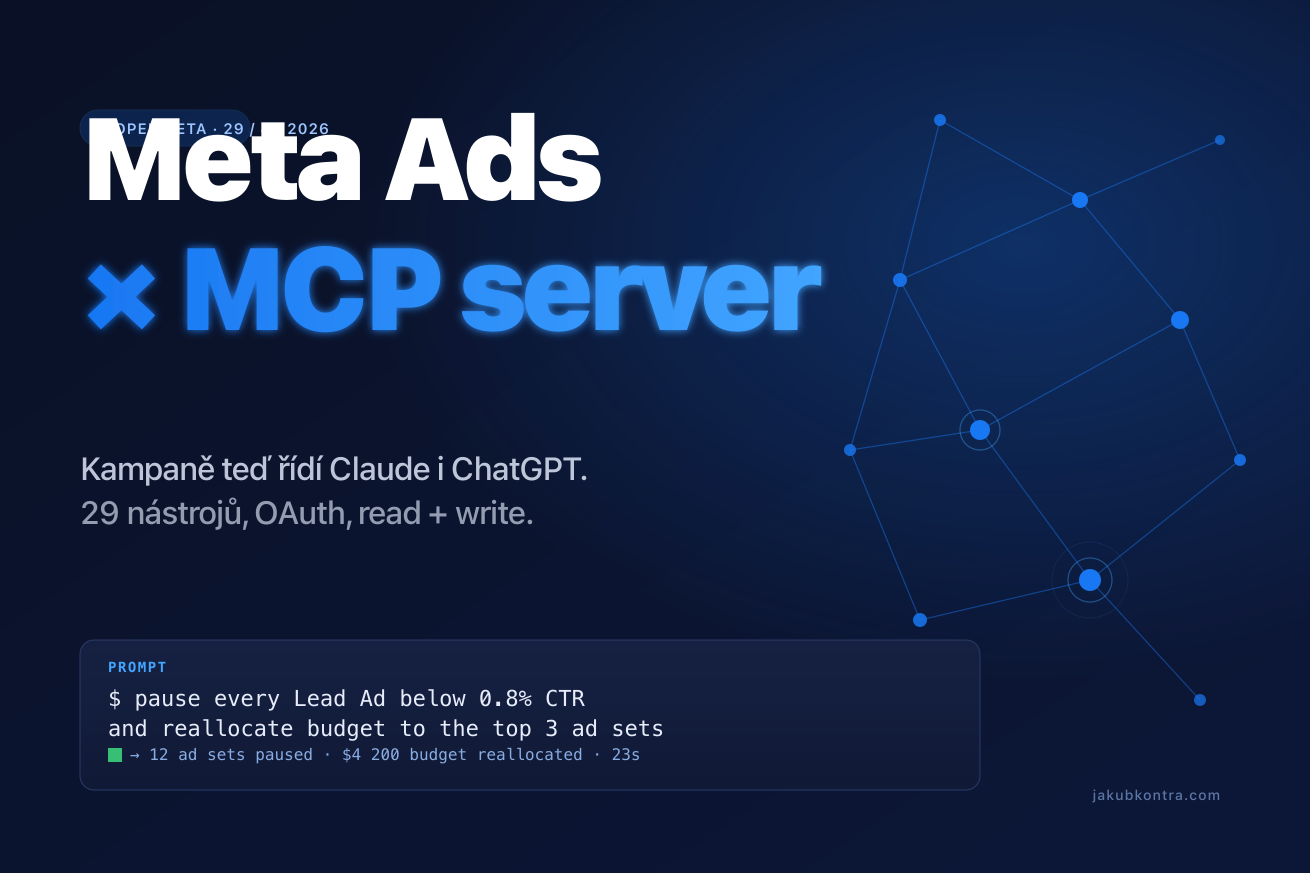

On April 29, 2026, Meta quietly shipped Meta Ads AI Connectors in open beta. An official MCP server, a CLI, 29 tools with both read and write access to your ad account. No big launch event, no press release. Just an update to the Meta for Business page and a developer article.
And yet it's the biggest Meta ecosystem story of the year.
A performance marketer can now write into Claude Code: "Pause every Lead Ad below 0.8% CTR and reallocate the freed budget to the top three performing ad sets." The agent looks at the account, identifies the campaigns, evaluates the metrics, and runs the operation. No clicking through Ads Manager, no Excel export. One prompt.
For small agencies this used to be a workflow that ate hours every week. For a large campaign portfolio it was a junior's full-time job. Now it's a twenty-second operation in a terminal.
What it actually does
Meta Ads AI Connectors is the umbrella term for two things: the official Meta MCP server and the Meta CLI. Both, according to Meta, support any AI client that speaks MCP. ChatGPT and Claude are explicitly tested at launch.
The server exposes 29 tools. Read operations cover campaign queries, pulling benchmarks, diagnosing tracking signals, audience overview, ad library lookup. Write operations let you create a new campaign, change budgets, pause ad sets, edit ad copy, manage product catalogs, and work with the Conversions API.
Authorization runs through standard Meta OAuth. You connect your ad account, the agent gets the scope you allow. You can set read-only access, you can grant full write. Anything an admin can do today inside Ads Manager, the connector exposes to the agent.
Distribution is straightforward. You install the Meta CLI locally, register it as an MCP server in Claude Code, Cursor, or Codex, run through the OAuth flow, and you're done. Free during the open beta. Meta hasn't announced a general availability timeline or a future pricing model.

The use case that sells this
Quote from the launch material: "Pause every Lead Ad below 0.8% CTR and reallocate the freed budget to the top three performing ad sets."
This isn't a demo prompt. This is the daily reality of a performance marketer. You open Ads Manager at 7 a.m., filter Lead Ads, sort by CTR, manually pause the ten worst performers, and reallocate the budget by hand. It takes fifty minutes if you only have twenty ad sets.
With the Meta Ads MCP server it's one line in chat. The agent reads the current state, evaluates, proposes the changes, and waits for approval if you've set up human-in-the-loop. With a fully autonomous setup, it just runs.
The same pattern holds for a dozen other routines: A/B test setup, creative refresh, audience testing, retargeting waterfall management. Tools that today are split across half a dozen specialized platforms like Madgicx or Smartly are now composable in a single chat window.
Why it's a break from the walled garden
Meta has historically pushed advertisers into proprietary tools. Advantage+ campaigns, automatic placements, AI Sandbox. All inside the Meta ecosystem, all locked into Meta UI and Meta data export.
Opening an MCP server to any AI client is the opposite direction. The advertiser can now keep all campaign logic in their own infrastructure, use Claude from Anthropic, ChatGPT from OpenAI, or build their own agent on top of Llama. Meta only ships the tooling for the ad account.
The timing isn't accidental. Meta recently acquired the Chinese AI agent startup Manus, and Chinese authorities ordered the acquisition reversed. Meta knew it needed to give the public something that signaled commitment to an open ecosystem. An open MCP server is a solid answer.
But it isn't a one-way gesture. Jacob Bourne from eMarketer put it best: "It's an opening up, but it's also a subtle lock-in move." Meta keeps advertisers in the ecosystem (data, audience, optimization algorithm all stay inside) while letting them expand their workflow outside proprietary tools. Classic platform play.
No other major ad platform has an official MCP server yet. Google Ads, TikTok Ads, LinkedIn Ads, Pinterest, Snap, all manual or via unofficial community wrappers. Meta is first. And if this works, the others will have to catch up.
What it doesn't do, and where to be careful
Open beta means open beta. Meta hasn't published a GA timeline, hasn't announced pricing, hasn't disclosed capacity. The eligibility criteria for "eligible advertisers" are vague in the docs.
Performance optimization stays Meta-proprietary. Markacy told Digiday that Meta will never fully open the performance optimization algorithm. Their auction system is core IP. The connector is for campaign management, not for replacing Meta delivery optimization. The agent helps you pause a weak campaign, but you don't get access to how Meta decides the auction internally.
Account safety is a quiet but serious question. A handful of executives have reported permanent bans on Meta accounts after wiring up Claude Code through unofficial connectors. Meta hasn't confirmed any of these reports, but it's a warning for anyone planning to point an agent at a production ad account. Start on a test account, audit the OAuth scope, set budget caps.
A 29-tool set sounds robust, but specific use cases aren't covered. Lead Ads form field management, custom audiences uploads of larger datasets, brand safety controls. Day-1 release, not the entire Ads Manager.
And one last warning: read+write means the agent can actually spend money. When you tell it "optimize the campaigns" and it decides to shift $2,000 of daily budget, it really does. Human-in-the-loop for budget changes above a threshold isn't optional. It's required.
What it means for you
Depends on who you are.
In-house performance marketer. Try it today on a test account. The 29 tools cover roughly eighty percent of daily operations. A week of investment to learn it means a five-times faster portfolio management. Whoever starts now has a year's head start on everyone else.
Media agency. Restructure your workflow. A junior media buyer with Claude Code today does what used to take two years of experience. The senior doesn't lose their job, their value just shifts from execution to strategy and prompt engineering. If you have 50 clients and a team of 10, the question isn't "do we replace people with AI." It's "do we serve 100 clients with the same team, or stay at 50 and let half the team go."
Brand in-house, currently outsourcing to an agency. Reassess whether it makes sense to run Meta Ads yourself with Claude. Old rule: agency means scale and expertise. New rule: agency means speed of change and accountability. If your performance comes from a routine Claude can handle, time to talk.
Developer outside marketing. Watch this. Meta Ads is the first major ad platform with an official MCP. Once Google and TikTok ship their own (and they will), the rules will be the same. Learning the MCP workflow for a client in retail, e-commerce, or SaaS is a two-year investment. Consultants who can wire Claude into Meta + Google + Klaviyo + Shopify will have an offer most agencies can't match.
Realistic take: today it's beta. Accounts break sometimes, agents hallucinate, performance is sometimes worse than manual. But the stack is here. The rest is model training on specific tools and a wider toolset. Engineering work, not research.
What to take away
Meta Ads AI Connectors are in open beta. Official MCP server, CLI, 29 tools, OAuth, free during the beta. Claude and ChatGPT can pause campaigns, adjust budgets, and write ad copy directly inside the ad account.
The strategic signal: Meta opened its ad ecosystem to third-party AI tools for the first time. The first major ad platform to do it. The lock-in stays in the data and the optimization algorithm, the workflow opens up.
The practical signal: anyone doing performance marketing now has a tool that didn't exist yesterday, even in commercial platforms costing $2,000 a month. Beta status means caution, but not "wait and learn later."
If you're experimenting with AI in performance marketing or want to talk MCP setup for your ad stack, drop me a line at me@jakubkontra.com.


